The Success of Heated Rivalry Should Not Be a Surprise
Romancelandia understands why the show is a hit. Why is it so hard for Hollywood to get the message?
by Gavia Baker-Whitelaw
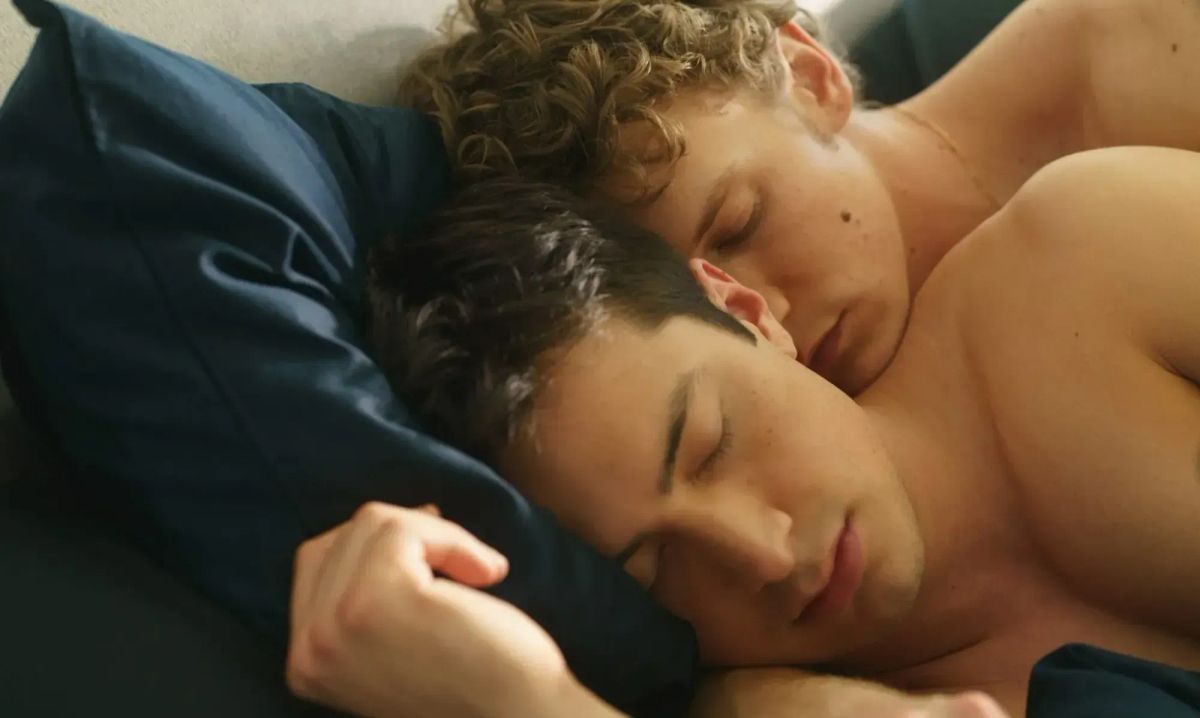
Shane and Ilya in episode 4 of Heated Rivalry. Image courtesy Crave.
As always, this article was brought to you by Fansplaining’s patrons. You may have seen that we recently announced that we’ll be transitioning to a full weekly publication about fan culture this spring. To help us commission more work like this piece for our relaunch (and beyond!), please consider becoming a monthly patron or making a one-off donation!
Much of the buzz around Heated Rivalry lingers on its role as an out-of-nowhere hit: as a lower-budget drama with no famous stars, as a release from a Canadian streaming service, and as a piece of m/m romance media that managed to break containment in an unprecedented way. At this point, it’s reaching Game of Thrones levels of mainstream attention, with lead actors Connor Storrie and Hudson Williams inspiring full-blown Beatlemania as they continue their publicity tour overseas—recently serving, beyond all reasonable predictions, as torchbearers for a leg of the Olympic Torch Relay leading up to next month’s games in Milan.
Among all this fervor, there’s been a steady stream of thinkpieces attempting to explain why, exactly, this show has sparked such a uniquely feverish reaction. Some coverage offers real insight into the Heated Rivalry phenom, but more often than not, we’re being treated to lukewarm takes on why “straight women” might enjoy a romance about queer men (please, I beg of you, rescue me from this musty old topic), accompanied by bewilderingly ill-informed commentary on the show’s overlap with both transformative fandom and queer media in general. (Why have multiple journalists drawn a direct connection with South Asian BL media, rather than the long-established popularity of m/m ships in general—aka slash—and hockey RPF specifically in Western fan culture? I remain bemused.)
Meanwhile in romancelandia, the excitement around Heated Rivalry comes with a different undertone. Here, the show’s success isn’t remotely confusing or mysterious. If you’re familiar with the expectations of romance genre publishing, you don’t need to resort to armchair psychology to explain the show’s appeal. Adapted by screenwriter Jacob Tierney from the Game Changers series by Rachel Reid, Heated Rivalry is one of a very short list of TV dramas that directly translates the escapist appeal of a romance novel. Focusing on two closeted hockey players named Shane and Ilya, it immerses us in the euphoric highs and agonizing lows of an obsessive, years-long secret affair, before concluding with a Happily Ever After (HEA); a defining element of the genre.
When it comes to romance on the small screen, Heated Rivalry’s most prominent predecessor is Bridgerton, and the hype around both shows reflects what the publishing industry has known for decades: Romance is a huge money-spinner, and if you deliver it in an accessible format, audiences will show up in droves. So the real question here isn’t why Heated Rivalry is a hit—it’s why this kind of romance series is so rare in the first place. Why is it so hard for the TV industry to adapt a genre whose tropes and formulas are as clearly defined as CSI? Why don’t we see ten new shows like this every year?

As longtime romance fan and literary critic Jenny Hamilton explained to me, Heated Rivalry follows a very classic kind of romance novel structure.
“The protagonists are drawn to each other,” she says. “There are external obstacles to them being together, as well as emotional obstacles that they're managing within themselves. Those obstacles push them away from each other for a time; they find a way to come together again; it's a happy ending, we all feel joy, roll credits.” Our satisfaction lies in watching these men navigate their emotional problems together and apart, and Heated Rivalry does a fantastic job of reshaping that story for episodic TV.
“Every episode until the fifth one ends on a point of disconnection,” Hamilton notes. We see Shane and Ilya misunderstand each other after various hookups, followed by a quasi-breakup between the secondary couple Kip and Scott in episode 3, and then the terrifically intense final scene of episode 4: a montage where Shane has sex with his new girlfriend while Ilya seethes with jealousy elsewhere.
Then, Hamilton continues, “Episode 5 seems set to end on a similar disconnect, with Ilya headed back to Russia. Instead, it gives us a really powerful moment of connection in the resolution to the Scott/Kip storyline, and a closing line that promises us a similarly happy resolution for Shane and Ilya.” I’ve seen numerous people name Heated Rivalry’s fifth episode as one of the best TV moments of the last year, because it’s just that effective at delivering that cathartic rush of seeing two characters finally get together after years of strife.
After reading the original Heated Rivalry novel, showrunner Jacob Tierney understood that these interpersonal conflicts had to be the focus of his adaptation, wrapping things up with a satisfying HEA. Giving actual hockey scenes a minimal amount of screentime, he prioritized sexual chemistry and emotional cues that deepen our understanding of Shane and Ilya’s relationship, digging into the psychological background for their anxieties and desires.
By the sixth and final episode, we have an intimate knowledge of a dynamic that’s evolved over the course of eight years, most of which our protagonists spent denying their feelings in a punishingly homophobic environment. Their happy ending is both a coming-together and a coming out—and it’s incredibly moving to see them figure out how to be open and affectionate with each other, and plan for a real future as a couple.
What’s interesting is how unusual this type of love story feels for TV. We’re used to seeing will-they/won’t-they romances play out as a secondary plotline in other subgenres, but that’s a different form of storytelling. Likewise, TV is full of relationship-centric dramas that don’t, structurally speaking, follow the traditional framework for genre romance.
Namechecking a handful of recent titles like Catastrophe, Colin from Accounts, and Nobody Wants This, Hamilton characterizes these relationship dramedies as more “irony-poisoned” than pure romance. Elsewhere, YA shows like Heartstopper and My Life With The Walter Boys do focus on love and relationships, but they also expand their scope onto a longform narrative with an ensemble cast. So while we still get plenty of movies that follow a conventional romance arc with an HEA (most obviously in mainstream romcoms and Hallmark-style films), the TV industry seems pretty reluctant to embrace the genre.
“Jacob Tierney has talked about how he really had to fight for his vision for this show,” says Hamilton. “There were a lot of networks they spoke to that wanted the show to be something different than ‘romance novel.’ I chalk it up to what Lili Loofborouw calls ‘the male glance.’ Basically she argues that there's a reluctance to ascribe artistry, meaning, and intentionality to art that women make. And I think that applies to romance, which people think of as being a girly thing for girls, and therefore not worthwhile.”
In an interview published before the series premiere, Tierney himself described this lack of respect for the romance genre as “pure misogyny,” saying that, “romance is something that mainly women consume, so it’s not given the same level of discourse.”
Alongside the problem of gender bias, there are more inside-baseball reasons for why romance might be seen as a difficult genre to adapt for TV. One potential issue is narrative structure. Romance novel plots are typically self-contained, best suited to a single-season format where the entire plot is dominated by the two main characters. This is what we see with many romantic dramas from South Korea, where the genre is a mainstream TV staple, and a lot of shows are designed to run for one season of 15-20 episodes.
By contrast, American TV is geared toward renewal for multiple seasons, which means more twists and turns, multiple characters starring in alternating subplots, and inconclusive season finales. The TV ecosystem is also strongly wedded to formulas that have proven successful many times in the past, whether we’re talking about family sitcoms or the kind of crime procedurals that run for a million interchangeable seasons.
Of course, Heated Rivalry and Bridgerton both undercut these assumptions about the adaptability of romance. Both shows wrap up satisfying stories in a single season, but they’re also adapted from series of interconnected novels, which isn’t uncommon for the genre. Bridgerton focuses on a different couple each season, while Heated Rivalry will go on to adapt a sequel novel about Shane and Ilya for season 2—and will hopefully continue with a third book, which is set to be published later this year. After that, Tierney could theoretically move onto some of Reid’s other novels set in the same universe, starring other queer hockey players in the background of Shane and Ilya’s story.
This format is now provably successful for TV—but the question remains whether the industry will acknowledge this reality and make more pure romance dramas in a similar vein. Producers could take cues from the recent run of prestige crime miniseries starring A-listers like Nicole Kidman and Kate Winslet. These shows are designed to tell a conclusive story in six or eight episodes, and can double as a star vehicle for actors who wouldn’t have time to film and promote a multi-season project. It’s a perfect format for romance. But biases against the genre won’t vanish overnight.
To get some insight into the Hollywood side of things, I spoke with an industry insider who’s worked on the development end of romance properties for major studios and streamers, and who shared some thoughts anonymously due to the confidential nature of their work. This insider immediately highlighted the male-dominated nature of film and TV as a key roadblock against traditional romance adaptations.
“I think the biggest issue is that many execs are still either men or women who are immersed in a very masc culture and they just Do Not Understand on a basic level,” they said. “I cannot tell you how many conversations I've had with dudes in the entertainment industry where I’m like, ‘I WANT YOU TO MAKE MONEY. I AM TRYING TO HELP YOU MAKE MONEY,’ and they do not get it at all.”
These executives do indeed perceive romances as one-off stories, our insider says, and are therefore more likely to embrace adaptations that feel like pre-existing types of serialized TV. “For example, Virgin River is a HIGHLY successful series based on a series of romance novels, but when you actually watch it it does not feel like a romance novel.” Now on its seventh season at Netflix, Virgin River has more of a small-town soap opera vibe, with an extensive supporting cast.
There’s also the issue of marketing. “Publishing has created a particular route to market romantic stories,” our insider explains. Like sci-fi or fantasy fans, romance readers are a specific subculture, fluent in tropes and trends that aren’t necessarily familiar to outsiders. “TV just does not have that same route, so people who love romantic fiction and are used to finding their stories in books that way do not have the same path to finding their stories on TV.”
American TV relies on longstanding strategies to create and market new crime shows, sitcoms, and SF/F dramas to their target audiences in a predictable manner. However, the romance genre is more diffuse, marketed on a case-by-case basis. Our insider notes that dramas like Virgin River are aimed at older, implicitly conservative audiences on the assumption that they’re more interested in “cozy” media, while Outlander occupies an ambiguous space as a quasi-romance project that doubles as a big-budget historical drama.
This marketing problem brings to mind something that Jenny Hamilton mentioned when we were discussing the massive audience response to Heated Rivalry, and how this show somehow circumvented the typical sexist biases against romance. She speculated that an underrated factor in Heated Rivalry’s success is its status as “a show about men by a male showrunner.” I think there’s some truth to that.
The idea of a female-lead Heated Rivalry is obviously an abstract hypothetical (the show’s plot is literally driven by toxic masculinity in men’s hockey!), but the focus on two male athletes is a clear reason why more men felt comfortable tuning in. And while straight bros have received a lot of media attention for enjoying the show (a phenomenon that was, in one controversial case, potentially exaggerated for clicks), Heated Rivalry has also been a huge hit with queer men who might not otherwise consider themselves to be romance fans.
As a piece of sex-positive entertainment with a happy ending, this show checks a lot of boxes for the kind of queer media people have been demanding for years. And while it’s more of a wish-fulfilment fantasy than a realistic drama, it speaks to a recurring topic in the discourse around queer representation onscreen. Namely, that its impact lies in telling a highly specific story, rather than making a lowest-common-denominator attempt to be accessible and universal.
Shane and Ilya are relatable in certain ways: the anxiety over a messy long-distance situationship, the stress of being closeted, the pressure Shane faces as a member of a racial minority in a majority-white environment. At the same time, their story is rooted in a setting that most people can’t identify with directly: the life of a famous athlete in a culturally insular sport. The show works because it’s well-characterized and sincere, with Tierney filtering Reid’s romance expertise through his perspective as a gay hockey fan, having spent the past few years working on the distinctly bro-y hockey sitcom Shoresy.
When we see “unexpected” audiences getting invested in Heated Rivalry, we’re not just seeing them discover the magic of romance. We’re witnessing a mass conversion to something that I’m sure all Fansplaining readers will understand: The joy of watching two people fall in love as a collective cultural experience.
Shane and Ilya’s love story has become a source of escapism during a notably bleak period in current events, and the public reaction reflects familiar themes from other TV shows where shipping is a key driving force in the fandom. The difference is that while, say, Destiel shippers have to do a lot of analytical legwork to extract their ship from the source text, Heated Rivalry delivers everything we need in a very direct and explicit way. It’s resultingly spurred normie audiences into a Tumblr fandom level of obsessive enthusiasm.
That’s heartwarming—and tellingly indicative of American TV’s inability to see the full scope of the romance genre. This should really be a wakeup call for studio executives who believe that love stories can’t succeed on their own. If Jacob Tierney can strike gold by adapting a tried-and-tested romantic formula, then other showrunners can surely do the same.
There are a lot of overlapping factors at play in Heated Rivalry’s success—the hunger for uplifting queer love stories, the charisma of Hudson Williams and Connor Storrie, the straightforward fact that it’s a very well-made show—but above all, it proves that there’s a huge untapped audience for romance. People really, really want to watch characters fall in love and get a happy ending, and it shouldn’t be so hard to make that happen.
Gavia Baker-Whitelaw is a journalist and critic. Previously a staff writer at the Daily Dot, you can find her work at various outlets including TV Guide, BBC Radio, Inverse, Vulture, and Atlas Obscura. She also co-edits “The Rec Center” with Elizabeth Minkel, and co-hosts the film and TV review podcast Overinvested, which recently released an episode on Heated Rivalry.