Can Fandom Make Us Better Tourists?

In an era of overtourism, South Korea’s Jeju Island and international BTS fans are building bridges of mutual respect.

by Kayti Burt

 
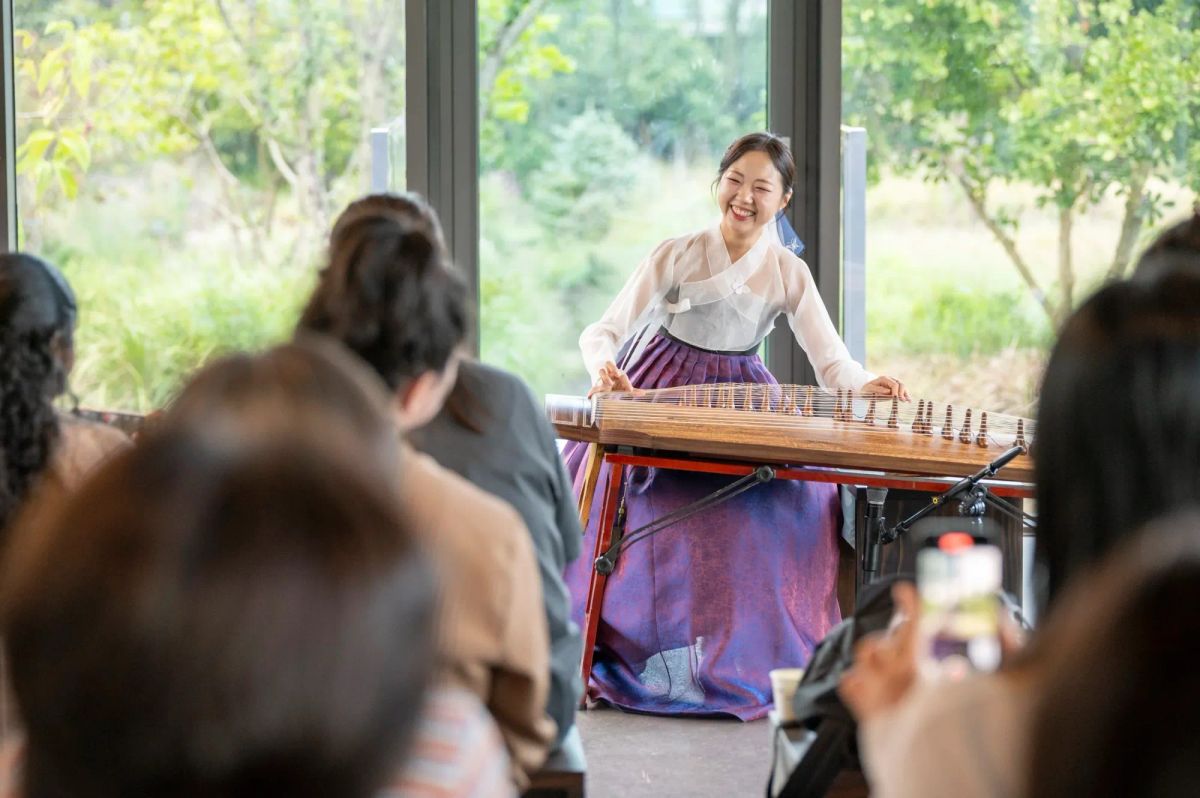
Photograph ofOh Hyun-ji playing gayageum in front of an audience, backdropped by green trees and bushes through floor to ceiling windows.

Oh Hyun-ji, aka Yageum Yageum, plays the gayageum at Purple Festa. Photograph courtesy Jeju Tourism Organization.

This article is brought to you by Fansplaining’s patrons. If you’d like to help us publish more writing like this in the future, please consider becoming a monthly patron or making a one-off donation!


The first time I ever hear a gayageum played in person, the Korean zither is being used to pluck the melody of “Mikrokosmos,” one of my favorite BTS songs. I am on South Korea’s Jeju Island, gathered with other BTS fans as part of a two-day event called Purple Festa—“purple” for the official color of BTS and their fandom (known as ARMY), and “festa” like the term used to describe the group’s debut anniversary celebration every summer. 

Hosted by the island’s local tourism organization, Purple Festa is designed to connect the pop culture that inspires fandom with the rich cultural traditions of Jeju and South Korea more broadly. Gayageum player Oh Hyun-ji is a good fit: the Jeju-born musician performs under the stage name Yaguem Yageum, interpreting K-pop and other trending music on what is perhaps Korea’s most famous traditional instrument. Also, Jungkook follows her on TikTok.

South Korea is the world’s fastest-growing tourist destination, on track to see a record number of visitors this year. Though not every tourist visits because of its pop culture—the broader “Hallyu,” or Korean wave, which includes K-pop and K-drama—roughly one-third of them do. Because of this, it isn’t just a tourist destination: increasingly, it’s a fan tourist destination. 

Fan tourism can take many forms. At its most basic, the term describes any travel behavior driven by fannish enthusiasm. When Game of Thrones fans visit Croatia to explore the real-world backdrop for Westeros, that’s fan tourism. When European soccer fans fly to Spain to watch one of the much-anticipated El Clásico matches, that’s fan tourism. When Sex and the City fans take photos on the steps of Carrie Bradshaw’s Manhattan brownstone—even when the property owner asks them not to—that’s fan tourism. 

Not every K-pop fan is lucky enough to live in a city, country, or even continent where artists tour, which means traveling for a concert is a cornerstone of K-pop fan tourism. But some fans take it a step further by actually going to the country that created the culture they love. 
When Life Gives You Tangerines was partly set—and partly filmed—on Jeju Island. Photograph courtesy Netflix.

While Seoul remains the central hub for most Korean tourism, Jeju is often a next stop. The island is a setting for popular Korean TV series like When Life Gives You Tangerines and Our Blues. The characters in animated smash hit KPop Demon Hunters have deep, spiritual connections to the traditions of Jeju Island. Many K-pop groups, including BTS, have filmed there. In 2024, the route between Seoul and Jeju was the world’s busiest flight path, with more than 13 million combined domestic and international travelers flying to the island of just 675,000 residents. 

In 2025, some of those Jeju visitors came for Purple Festa. The creative brain behind the event was Kim Youngmi—a BTS fan herself. Young-mi runs the Korean event planning company Big Movement, which has been working with Jeju Tourism Organization for almost four years, “exploring how travel, fandom, and locality can harmonize together.” While much of fan tourism is focused around festivals, concerts, or other kinds of one-time events, Young-mi hopes to establish a “sustainable fandom tourism model” that connects fans more deeply with Korean culture.


In an age of overtourism, popular destinations around the world are in need of more sustainable tourism models. South Korea hasn't been hit as hard as Japan when it comes to international tourism, but the number of travelers coming to the country is surging. Earlier this year, Seoul's Bukchon Hanok Village implemented a tourist curfew because the crowds had become so disruptive to locals who live in the neighborhood. 

A month before Purple Festa, Jeju put out a tourism conduct guide. Written in English, Chinese, and Korean, it cited incidents of “inappropriate behavior,” including smoking in restricted areas, jaywalking, drunken disturbances, trespassing, and the use of fake IDs. Given the notable influence of pop culture on Korean tourism, it stands to reason that at least some of this “inappropriate behavior” probably came from fans. 

Pop culture can foster a deep sense of intimacy and connection to a place that someone has never actually visited. In the Sex and the City example, fans feel a sense of ownership of Carrie Bradshaw’s brownstone because, in a fannish sense, they have spent years in that space. (For another example of a fictional address clashing with peoples’ real lives, take fans hopping the fence at 4 Privet Drive.)

Of course, in a real-world context, fannish connections award fans no right to do whatever they want on someone else’s private property. But there’s an emotional confusion—and in some cases, an entitlement—that can lead fans to treat other people’s homes like their own fannish adventures. While it’s easy to dismiss extreme examples of this entitlement as incomprehensible , it can be helpful to discuss the emotional connection from which these desires can stem. 

Fannish intimacy with a place that is quite literally not our home can make fans rude tourists, but it can also make fans respectful ones—especially when it’s well-directed. Cross-cultural fandom in particular encourages us to learn about cultures outside of our own. It helps us better understand the world and our place in it. In the best cases, fandom makes us better tourists, because travel can be a manifestation of that curiosity and desire for self-expansion.


I first learned the term “self-expansion” from SoJung Lee, a professor at Iowa State University who studies pop culture and fan tourism. In its original form, self-expansion theory posits that close relationships, including the ones between romantic partners, can serve as a way to expand our sense of self as we incorporate the identities, perspectives, resources, and experiences of others as our own through these relationships. SoJung wrote her 2012 dissertation on how the model can be applied to parasocial relationships and fan tourism. She argues that pop-star fans possess a strong self-expansion desire, which affects their fan behavior and commitment to a celebrity.

This tracks with my experience of BTS fandom—and my fandom experiences outside of K-pop. Once I become a proper fan of something, it’s a lens through which I strive to better understand both the world and myself. There are limitations, of course, but the fandoms that tend to grasp me the tightest offer the greatest chances at expansion. I value my BTS fandom for the ways in which it de-centers and challenges American and Western frameworks in my thinking, particularly when it comes to subjects like masculinity, performance, and collective culture.  

 
Image of a group of BTS fans learning a dance, with their right arms extended in the air.

Dancing Bora teaches Purple Festa attendees the choreography to BTS song “Run, BTS.” Photograph courtesy Jeju Tourism Organization.


SoJung and PhD student Nuri Choi are currently interviewing BTS fans from around the world about fan-related travel and how it can deepen to take on the status of “fan pilgrimage.” “Participants [in the study] describe being drawn to BTS not only through music or performance, but through the group’s authenticity, humility, and emotionally resonant narratives,” SoJung tells me. She has found that the group’s messages of healing, self-love, and perseverance can be particularly affecting during moments of personal and collective crisis. 

For fans like me, it’s not a big jump to incorporate that fannishness into our identities, bolstered by communal experiences of fandom. “Many fans travel with friends they met through BTS, attend events as family units, or maintain global networks centered around fandom activities,” explains SoJung. In some cases, the spaces we visit take on symbolic importance. “Concert venues in cities like Fort Worth, Los Angeles, or New York are remembered as transformative locations,” she says. “Korea emerges as a cultural and spiritual ‘home base’ for fans.” 

A pilgrimage is a journey to a place that holds special or even sacred meaning to the traveler—so when the emotional or spiritual significance of fan tourism deepens, it can take on the status of fan pilgrimage. When I chat with other ARMY who attend Purple Festa about what BTS means to them, they speak about the group’s presence in their life as a source of solace and self-acceptance. For them, it is more than a trip: it truly takes on that pilgrimage status.


Deeper connections are exactly what Purple Festa organizer Young-mi is hoping the event will foster. “From the Jeju Tourism Organization's perspective, Jeju serves as more than just a tourist destination,” says Young-mi. “It can act as an ‘emotional bridge’ [to BTS].” 

Purple Festa’s first day takes place at Veke, a garden-centric event space that BTS member Jin visited during his appearance on variety show Handsome Guys. We are instructed on how to wrap objects (in this case, the book BTS, Art Revolution) in bojagi, traditional Korean wrapping cloth. We learn about BTS member Namjoon’s favorite modern and contemporary Korean artists from Professor Jin Young-seon. “Dancing Bora” tries to teach us the choreo to “Dynamite.” That this all takes place on Namjoon’s birthday only adds to the emotional significance of the day.

 
Image of two Purple Festa attendees sitting at a table wrapping books in blue cloth, with an instructor standing between them.

Cho Ye-sung teaches a Purple Festa attendee how to use traditional Korean bojagi. Photograph courtesy of the author.


While Purple Festa continues with a second, more K-drama-themed event in Jeju City, I opt instead to tag along on the Equal Sign Tour. (Full disclosure: Young-mi offered to comp my hotel stay for The Equal Sign Tour when I initially reached out about Purple Festa). Named after a song by BTS rapper j-hope and sponsored by Korean low-cost airline T-way, the tour was designed for BTS fans who are wheelchair users to explore the island. I travel alongside Aia from the Phillipines, Yu Qi from Singapore, and Karlina from Indonesia, as well as several of their family members.

For four days, we make up a jolly tourist team. Every morning, we pile into a wheelchair-accessible van to visit sites—both BTS-oriented and not—around the island. We see a Cirque du Soleil-like show at Aqua Planet aquarium, visit Snoopy Garden like Jimin, and see the world-famous haenyeo divers working in the sea. We try mulhwe, one of Jin’s favorite foods, and joke about re-enacting the Are You Sure? Scene when a shoeless Jimin chases V down the street in order to serve him a bite of food. The restaurant where it took place plays Are You Sure? scenes on repeat; two BTS fans from Poland have snagged the window seats where the members once sat. 

 
Yu Qi,From left to right, Yu Qi, Karlina, and Aia, all sitting in wheelchairs and waving to the camera, situated on a stone bridge.

Yu Qi, Karlina, and Aia pose for a photo at Cheonjiyeon Falls. Photograph courtesy the author.


In between destinations, we share biases—the K-pop term for your favorite artist—and sing along to the BTS playlist our tour guide made. The shuttle bus becomes our own noraebang. When we take the ferry to Udo, a tiny island off the coast of Jeju, we eat peanut ice cream and make a collective wish to get concert tickets for the next BTS tour.  


When I speak to Young-mi and the other Korean organizers behind Purple Festa, they repeatedly bring up a specific goal: to provide an accessible bridge between Korean pop culture and traditional Korean culture. Use of the word “bridge” seems notable, because it’s a cultural distance that is not easily traversed without help. 

At Purple Festa, the hosts offer specific and sustained guidance to us foreigners, mediating the disruptions we might cause to the spaces we visit, and guiding us towards experiences of connection and community, rather than consumption or extraction. Professional duty or not, they are eager to share—both their Korean culture and their BTS fandom. It’s that spirit of sharing and community that’s at the heart of all positive fan tourism I have experienced. 

 
Image of two people holding mics and smiling wildly, one of them holding a cake with a small blue koala sitting on top.

Interpreter April Kim holds a birthday cake for Namjoon’s birthday. The cake was baked by fan Susanne Ng, who stands beside her. Photograph courtesy Jeju Tourism Organization.


What, then, is at the heart of negative fan tourism experiences? A lack of Purple Festa-esque guidance is usually a key factor. Often, locals don’t have the opportunity to guide—they are simply overrun. Scotland has been struggling with this for years, with visitors clogging tiny rural roads and leaving behind litter and human waste in their quest to see the Glenfinnan Viaduct from the Harry Potter films, or Outlander (and Harry Styles music video) setting the Isle of Skye.

But sometimes, the guidance is simply absent. Some of the worst fan tourism behavior I’ve seen has been at concerts where tens of thousands of eager fans try to get into a stadium. Without clear instructions, fans will cut long lines of people who have been waiting for hours, or run in ways that can become dangerous in crowds. There are no authorities telling fans what they should and should not do—and fans, in their excitement, feel entitled to do whatever they want.

Entitlement is the belief that you’re inherently deserving of privileges or special treatment. In K-pop fandom, this could manifest as thinking you deserve concert tickets more than another fan, or a better position at the concert, or for an idol onstage to perceive you specifically. Many fans wish for these things to happen for them, but it crosses over into entitlement when you believe that you have more of a right to experience it than others, regardless of others’ boundaries and experiences. I’m not in the business of policing thoughts and feelings, so I would argue that this sense of fan entitlement only becomes a problem when someone acts on it. A small example might be cutting a few people in line to get into a concert. A big example might be stalking your favorite idol to a hotel or an airport.

When looking for studies about entitlement, I stumbled upon a paper proposing that academic entitlement tends to be higher in students who treat university education in a transactional manner rather than as a place of exploration, growth, and personal development. I wonder if that theory could be applied here. Is fan tourism at its worst when fan tourists treat travel and cultural experiences solely in a transactional manner, rather than as an opportunity for exploration, growth, and personal development?

As countless examples of “Karen” behavior across social media will tell you, transactional relationships are used as an excuse to cover all manner of bad behavior. I think this can be true in fandom, too. Concerts can cost hundreds if not thousands of dollars to attend, before taking into account the cost of a flight and hotel. I think this is playing a role in some of the entitled fan behavior we’ve seen at pop concerts, ranging from the annoying to the dangerous. You’ve paid a lot to be there; you should get to do exactly what you want.

We look at many parts of fandom with a transactional framework. Most fannish behavior is inextricably linked to consumption at some point in the process—such is the nature of pop culture under capitalism. But when we put too much weight on these transactions or in the hierarchies they often come along with, fan entitlement can take root and grow. 

But the best of fandom isn't transactional. It’s moments of unlikely connection between strangers or friends who might not have crossed paths, let alone traveled them together, if not for loving the same thing. It’s recognition that none of this fandom stuff would be as fun if we weren’t doing it with other people. Purple Festa was a fan tourist event built on that sentiment, which made it easy to expand our shared interest in BTS past the usual confines of our fandom into something much larger. 

 
Group photo with two rows totalling a dozen people. The back row stands; front row mostly squats, and includes one wheelchair user. Most people wave/make peace or other hand signs. Two hold the blue koala cake. Background a lush green garden.

Purple Festa attendees with Veke owner Kim Bong-chan. Photograph courtesy Jeju Tourism Organization.


It took both sides of the equation to work. The organizers created an open, welcoming space for visiting fans, eager to show us their culture. Visiting fans were excited to approach the event on those terms, leaving behind any narrow, self-centered conceptions of what Jeju must do or be for us as BTS fans.  

When crossing a fandom-made bridge, try to remember you didn’t build it alone. Fan tourism can be overwhelmed rural towns and self-important line-cutters, but it can be Purple Festas, too. It can be a gayageum played on a rainy Jeju day, giving us something to share. In your fandom future, I wish you fewer line-cutters and many Purple Festas. To quote “Mikrokosmos,” “The lights we saw in each other / Were saying the same thing.”


If you liked this article, please help us make more! Become a patron for as little as $1 a month, or make a one-off donation of any amount.


Image of Kayti wearing a mask and holding a lightstick at a kpop concert.

Kayti Burt is a pop culture writer and editor based in New England. She’s been published in Rolling Stone, the LA Times, Vulture, TIME, Polygon, Den of Geek, and more. At Paste, she explores Korean idol music from an American perspective in her “K-Pop Talk” column. She is a member of the Television Critics Association and the Freelance Solidarity Project.

 
Kayti Burt